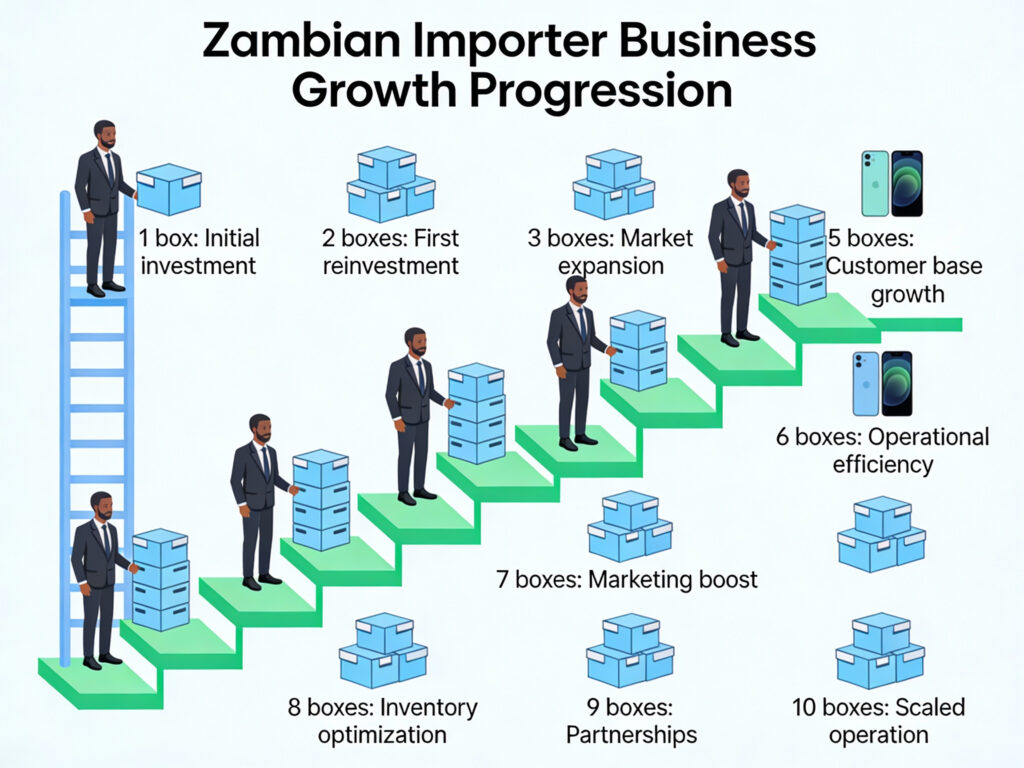
Most people only talk about success after it happens. This case study focuses on the early stages before growth becomes visible. Chanda started importing phone accessories with limited capital and no prior experience. By reinvesting consistently and avoiding common beginner mistakes, he scaled from one box to ten boxes. This article documents his decisions, costs, profits, and lessons step by step.
Step 1: Starting Point — Capital and Product Choice
Chanda began with K3,000 in capital. Instead of stocking many items, he focused on a single fast-moving product: phone chargers. He chose chargers because demand is constant, breakage rates are low, and replacement purchases happen frequently.
Key considerations at this stage:
- Easy storage
- High repeat demand
- Low risk of obsolescence
Step 2: First Import Order Details
Chanda placed his first order from Dubai to reduce risk and delivery time. He ordered one box containing 120 phone chargers.
Cost breakdown (approximate):
- Product cost: K1,800
- Shipping & handling: K700
- Miscellaneous costs: K200
Total landed cost: ~K2,700
The remaining capital was kept as a buffer for reinvestment and emergencies.
Step 3: Sales Strategy
Chanda focused on direct-to-customer sales rather than wholesale at the beginning.
Sales channels used:
- WhatsApp Status
- Facebook Marketplace
- Local phone repair shops
He priced chargers competitively and offered small discounts for bulk purchases.
Step 4: First Sales Results
The first box sold out within 3 weeks. Demand was strongest among commuters and small retail shops.
Average selling price:
K35–K40 per charger
Total revenue (first box):
~K4,500
Step 5: Reinvestment and Scaling Decisions
Instead of spending profits, Chanda reinvested immediately. His second order increased to three boxes, followed by five boxes and eventually ten boxes once demand was proven.
Scaling strategy:
- Increase order size gradually
- Maintain the same product
- Improve supplier relationship
- Reduce unit cost over time
Step 6: Profit Breakdown
As order sizes increased, costs per unit dropped.
Estimated profit per box:
K2,500–K3,000
By the time Chanda reached ten boxes, his monthly profit had become consistent rather than occasional.
Step 7: Mistakes and Lessons Learned
Chanda made mistakes early, including:
- Underestimating demand
- Running out of stock
- Delayed reorders
Key lessons:
- Always reorder early
- Keep a simple product line
- Cash flow matters more than variety
Step 8: What Beginners Can Learn from This Case Study
This case study shows that:
- You don’t need large capital to start
- Consistency beats speed
- Reinvestment drives growth
- Simple products scale faster