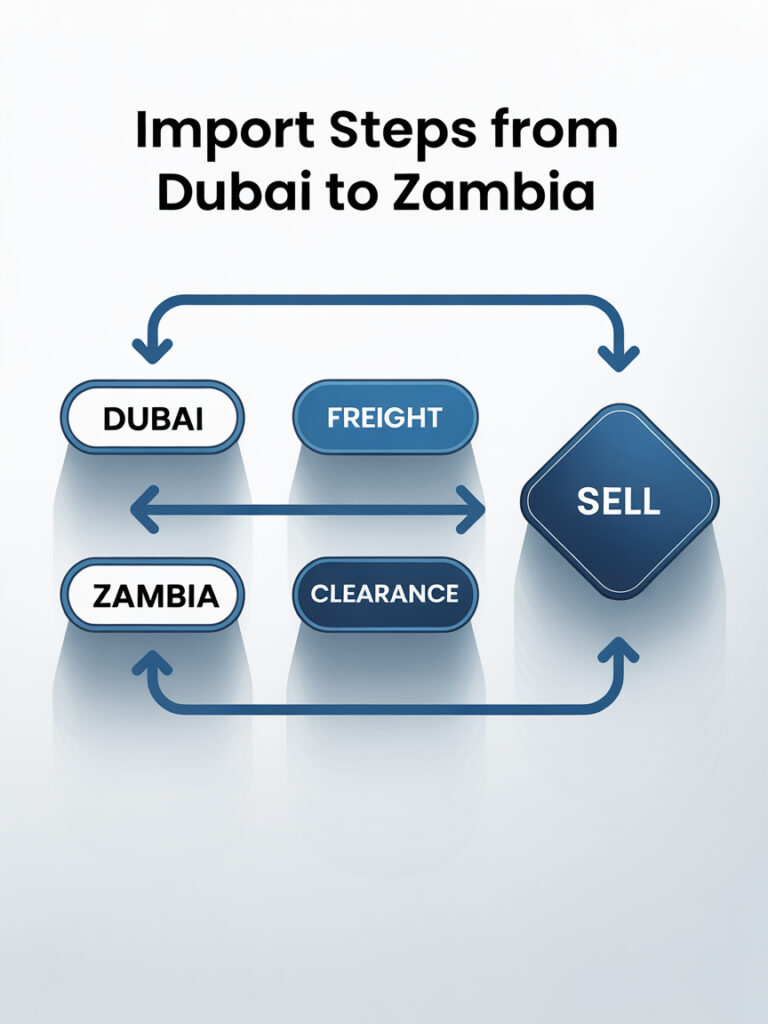
Dubai is a fast, reliable source for phone accessories — from chargers to screen protectors — but small importers often get stuck on costs, suppliers, and customs. This guide walks you through each step to import a small batch from Dubai to Zambia with minimal risk and clear cost breakdowns.
Step-by-step:
1. Choose Your Product & Estimate Demand
Start with accessories that have consistent demand in Zambia:
- Fast-charging adapters
- USB-C, Lightning, and braided cables
- Tempered glass (2.5D/3D)
- Protective phone cases
Do a quick market check:
- Review top sellers in Facebook Marketplace, tech groups, and TikTok shop creators
- Talk to small retailers
- Compare prices across local stores
This gives you a realistic idea of what sells and the margins.
2. Find Suppliers in Dubai
Dubai’s Deira district is the main wholesale hub, but you don’t need to physically be there. Many suppliers share stock on:
- TikTok
- Facebook groups
- WhatsApp broadcast lists
When filtering suppliers, always check:
- Product photos and videos
- Location (Deira, Naif, Bur Dubai)
- MOQ (Minimum Order Quantity)
- Available brands or qualities
- Shipping options (air cargo, courier, sea)
Ask for at least three quotes to compare.
3. Request Samples & Verify Quality
Before committing to bulk orders, get 1–2 samples shipped to Zambia.
Things to check:
- Charger wattage & voltage stability
- Build quality (cable strength, connector finish)
- Packaging type & durability
- Screen protector clarity and adhesive quality
Soft HVGadgets reference:
HVGadgets recommends testing charger voltage and overall build quality before placing bulk orders — especially for fast-charging accessories.
4. Get Shipping Quotes (Air vs Courier vs Sea)
You can ship to Zambia through:
- Steadfast Cargo Services LLC
- Fast Forward Logistics
- MyBox Logistics
For small quantities, air cargo or courier (DHL/Aramex) is faster and easier.
Sea freight is cheaper but slow and only makes sense for larger consignments.
Typical outcomes:
- Courier = higher per-unit cost, fastest arrival
- Air cargo = balanced option for SMEs
- Sea = lowest cost but slowest (30–60+ days)
Always ask for:
- Per-kg rate
- Minimum weight
- Delivery timeline
- Clearing fees (if any)
5. Calculate Your Landed Cost (Very Important)
Your selling price depends on your true landed cost.
Formula:
Product Cost + Shipping + Customs Duty + Clearing + Local Transport + 5–10% buffer
Example:
- Unit cost: K40
- Shipping per unit: K10
- Duty & clearing: K6
Landed cost = K56 per unit
Without proper cost calculation, you risk selling at a loss.
6. Prepare Documentation
Your supplier or freight forwarder must provide:
- Invoice
- Packing list
- Airway bill / Bill of Lading
Use a reputable clearing agent to avoid delays and unnecessary charges.
7. Order, Track & Plan Local Logistics
Dubai payments are mostly made through cash agents, so work only with someone reputable and verified.
Once payment is confirmed, track your shipment and prepare for:
- Collection from the cargo agent
- Sorting and storage
- Listing the items for sale
- Deliveries to customers or retailers
Always record stock and costs — even for small batches.